
Slow Food & Agriculture · Food & Farming · Slow Life
Seed Saving Is an Act of Defiance
Published 19 January 2026 · By Jen Marsden
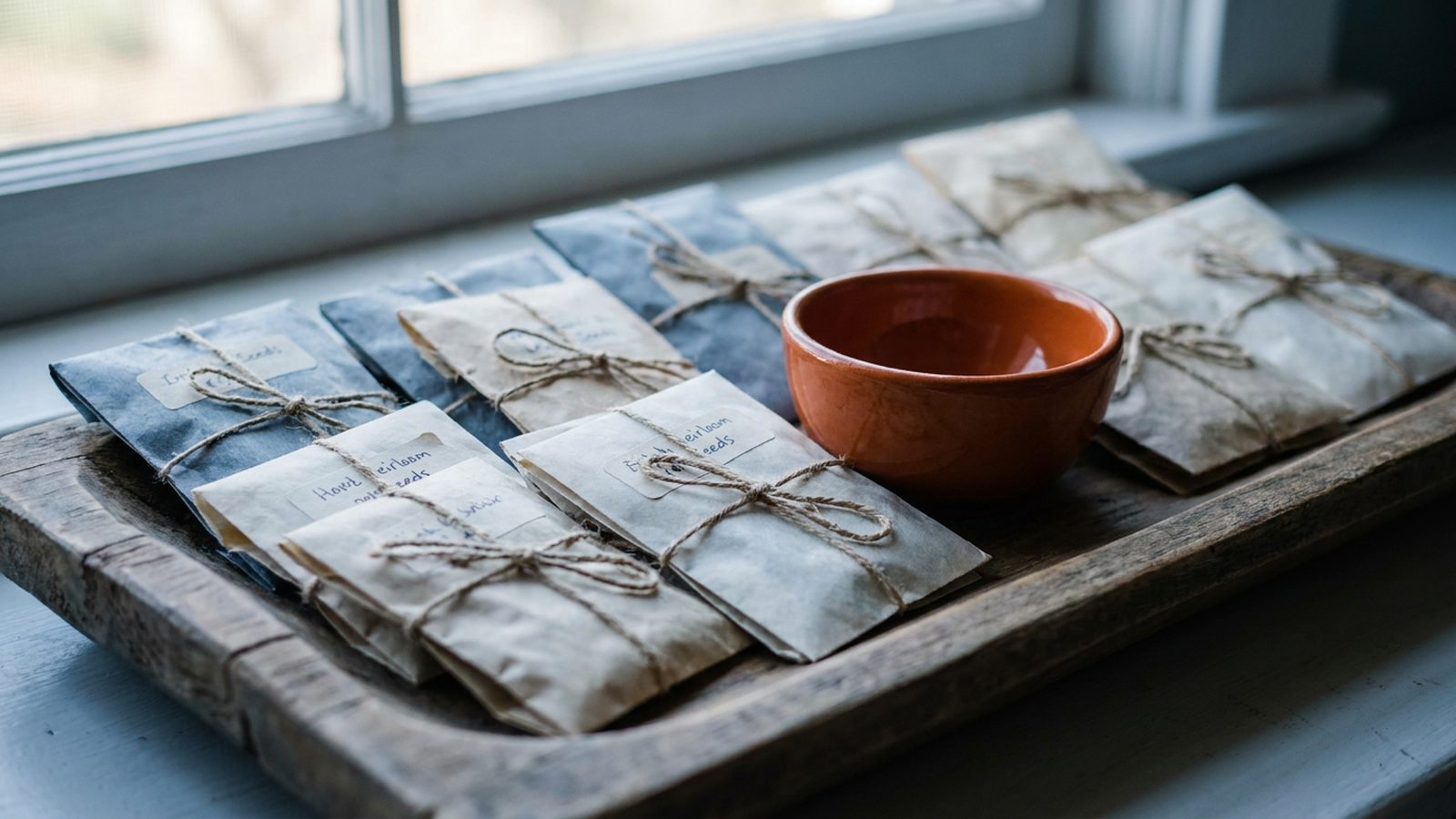
What could be quieter than saving a seed? You let a bean pod dry on the plant, split it open, and tuck a handful of seeds into an envelope for next year. Nothing about it looks like resistance. And yet, in a world where a handful of corporations control an enormous share of the seeds that feed us, keeping your own is one of the most quietly defiant things a person can do.
For most of human history, saving seed was simply how growing worked. You kept the best of this year’s crop to plant next year, and over generations your seeds adapted to your soil, your climate, and your table. Every valley and every family had its own varieties, shaped by the particular hands that tended them. This was not a hobby. It was the foundation of food itself, held in common and passed along like any other inheritance.
Then, gradually, that changed. Seed became a product to buy rather than a thing to keep. Many modern commercial varieties are hybrids that do not breed true, which means the seed you save will not reliably reproduce the plant you grew, so you must return to the supplier each season. Some are protected by patents that make saving them a legal matter rather than a natural one. Step by step, a practice as old as farming was turned into a purchase, and the knowledge that went with it began to thin.
Why saving seeds is important
This is why seed saving carries more weight than its gentle appearance suggests. Every seed you save is a small refusal to depend entirely on that system. It is sovereignty in the plainest sense, the ability to feed yourself next year without asking permission or opening your wallet. On its own, one saved seed changes little. But sovereignty compounds. A saved seed becomes a saved variety, which becomes a swapped variety, which becomes a whole network of growers quietly keeping alive what the market would happily let disappear.
That compounding is the heart of it. When you save seed from your strongest, tastiest, most resilient plants, you are not just storing next year’s crop. You are selecting, gently steering the variety towards what thrives in your particular patch of the world. Do this over several seasons and you begin to develop something genuinely local, adapted to your conditions in a way no mass-produced packet ever could be. Multiply that across a community and you have a living library of diversity, far sturdier than any single commercial line.
The bigger picture of seed saving
There is a bigger picture worth naming plainly. The narrowing of our seed supply is a real vulnerability. When vast areas are planted with a handful of genetically similar varieties, a single disease or a shifting climate can do enormous damage. The old diversity, those thousands of local varieties shaped over centuries, is a kind of insurance we have been quietly cashing in. Seed savers, often working in back gardens and allotments with no grander ambition than a good tomato, are the people keeping that insurance alive.
You do not need to be an expert to take part, and that is rather the point. Start with something forgiving. Beans, peas, tomatoes, and lettuce are all generous teachers, happy to be saved by a beginner. Let the plant mature fully, collect the seed, dry it well, and store it somewhere cool and dark with a label you will still understand in six months. Next spring, plant it and watch your small act of defiance come up green.
Share your saved seeds
Better still, share what you save. Seed swaps, community libraries, and a handful of envelopes passed over a garden fence are how varieties survive and spread. A seed kept in a jar is preserved, but a seed shared is alive, moving through hands and gardens, adapting and enduring.
So this season, let something go to seed on purpose. Save a little, label it, and plant it next year. It will feel like almost nothing, a bean pod and an envelope. But sovereignty compounds, one seed at a time, and the quietest acts of defiance are often the ones that last longest. Your garden is a good place to begin.
Need words like these?
Let us write for you
Blogs, newsletters, brand copy and more, from a Highland collective that keeps it human.